
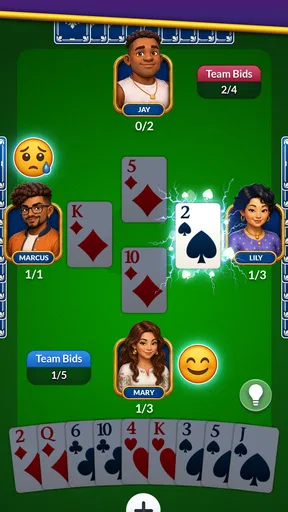

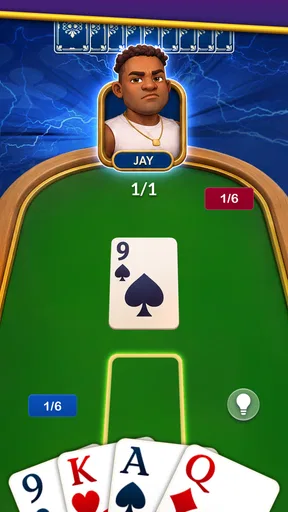
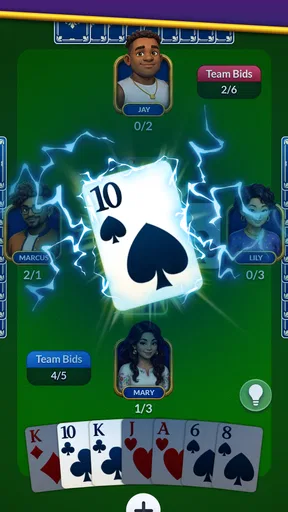

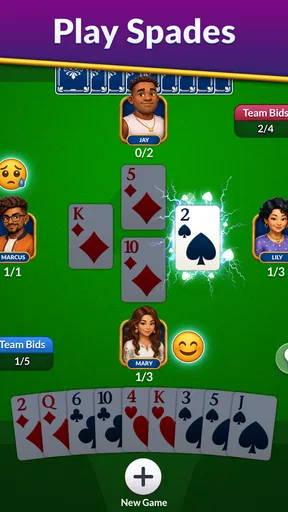
Spades - Classic Cards review
 Analysis by GetAllApps
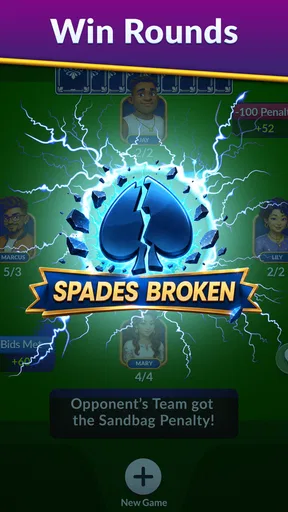
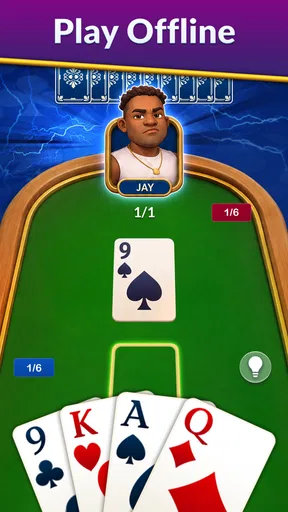
I’m drawn to card games that are easy to pick up but still reward a little thought, and Spades - Classic Cards fits that space well. It gives the familiar trick-taking game a straightforward mobile format: the rules are recognizable, hands move quickly enough for a spare moment, and each round asks you to weigh your own cards against what your partner and opponents may hold. My first impression is that it works best as a dependable way to play Spades on a phone, rather than as a deep strategy game or a social substitute for a table full of friends.
Easy to start, with decisions that matter
The opening appeal is the low barrier to entry. If you already know Spades, you can settle into a hand without learning a new game system. If you are rusty, the basic rhythm is still approachable: judge the strength of your hand, commit to a bid, then try to take the tricks you promised. The tension comes from making a sensible estimate before you know how the cards will fall.
That makes the game a good fit for short breaks. I can imagine playing a round while waiting for a kettle to boil or filling a quiet few minutes between errands. It does not demand the preparation or sustained attention of a longer strategy game, yet it gives me a reason to think beyond the card I am about to play. A high card may win a trick now, but spending it carelessly can leave a weak suit exposed later.
The most useful habit for a newer player is to treat bidding as a judgment call, not a wish. Count likely winners, consider how many spades you have, and be cautious about assuming your partner will rescue an uncertain hand. During play, keep track of which suits have already been led and whether spades have become available to trump. Those small observations make the game feel less like guesswork without requiring a notebook or a long study session.
Because this is a mobile version, it is especially convenient when I want the structure of a complete card hand without arranging a group. The trade-off is that playing alone against a digital table does not recreate the conversation, table-reading, and friendly pressure of an in-person game. If that social element is the main reason you enjoy Spades, a phone game can fill a gap but cannot fully replace a regular group.
What the first week feels like
In the first few sessions, the appeal is repetition with variation. The rules stay familiar, but each hand changes the problem: sometimes I have enough strong cards to bid confidently; sometimes the safer choice is to avoid overpromising and focus on limiting mistakes. This makes the game easy to revisit without needing a campaign, a story, or a complicated progression system to explain why another round might be worthwhile.
Tripledot Studios Limited is the developer, and the game is listed as a free card game for everyone. It has a 4.8 average from around 53,000 ratings, with more than a million installs. Those figures suggest a broad audience, but I would treat popularity as a reason to give it a try, not proof that its particular style will suit every Spades player.
One practical question is whether it is approachable for someone who only remembers the basics. I think it is, provided you are willing to learn through play and accept that early bids may be imperfect. A useful approach is to focus on one lesson per hand: did you overestimate winners, misjudge your spades, or spend a key card too soon? That turns a casual round into a small feedback loop instead of a string of unexplained wins and losses.
Why it can remain useful after the novelty
The long-term value of a classic card game depends less on surprise than on whether its decisions stay satisfying. Spades has a natural source of replayability: the cards change, but the challenge of estimating your hand and coordinating your play with a partner remains. I find that more durable than a game whose appeal depends entirely on unlocking a steady stream of new content.
There is also a nice fit between the game and small pockets of time. A quick session can be a deliberate break from scrolling, while a longer spell can become a run of hands when I am in the mood to improve. The key distinction is that I do not need to make a daily commitment for the game to make sense. It can be something I return to when I want a familiar mental challenge, rather than another app demanding a routine.
For better decisions, I would pay attention to the difference between a hand that looks strong and one that can reliably take tricks. Aces and high cards are useful, but the shape of the hand matters too: a long suit can create opportunities, while gaps in other suits may leave you vulnerable. After a round, remembering one or two pivotal cards is more practical than trying to reconstruct every play. That modest review can make later bidding more confident without turning leisure into homework.
The game’s position in the card category is clear. Compared with solitaire, which is usually a solo puzzle of arranging cards, Spades asks me to forecast outcomes and respond to other players’ choices. Compared with a full physical game, it is quicker to access but less personal. If I want a calm solo pastime, solitaire may be the better choice; if I want a bidding game with partner-oriented decisions, this is the more relevant option.
Keeping it installed without adding chores
Maintenance is an important part of whether a casual game earns lasting space on my phone. The current version is 1.16.00, and the minimum operating system is 7.1. I would expect to check compatibility before installing on an older device, but for someone with a supported phone, the basic commitment is simply to open it when a hand sounds appealing. Its release date is August 23, 2024, so it is a relatively recent mobile entry rather than a long-established app I would choose for a history of years of updates.
It is free to download, with in-app purchases listed from $0.99 to $99.99 per item. That range is worth noticing even if you intend to play casually: optional purchases can affect how comfortable an app feels over time, especially if prompts or paid extras become a distraction. I would start without spending and decide later whether anything offered genuinely improves my own use. A free starting point does not mean every possible purchase is necessary.
For everyday use, I would keep the game in the category of “available when I want it,” not something I need to check every day. That is a healthier match for a card game built around individual hands. If you are trying to reduce screen time, setting a natural stopping point—such as finishing the current hand—can help prevent a quick break from turning into a much longer session than intended.
Where the routine can wear thin
The same consistency that makes Spades comfortable can also create fatigue. Once the rules and basic choices feel familiar, a player looking for new modes, a strong sense of advancement, or a changing world may find that hands begin to blur together. I would not choose it for variety in the way I might choose a collection of different card games. Its strength is focus, and focus can feel narrow if I want novelty.
There is another limit to consider: the strategic quality of a partnership game depends on how well the other side behaves. In a phone adaptation, I cannot assume the experience will feel like reading a human partner or negotiating a shared plan through conversation. For some players, that is perfectly fine; the point is simply to play hands. For others, adapting to a digital table may feel less rewarding than meeting friends for the physical game.
It is also not the right pick for someone who dislikes bidding or the uncertainty that comes with it. Spades asks you to make a commitment before the hand is fully known, then live with the consequences. If you prefer a card game where each move is a self-contained puzzle and mistakes are easier to isolate, a solo format may feel fairer and more relaxing. Here, a poor estimate can shape the rest of the hand.
The age rating is Everyone, which makes the game broadly suitable as a casual card option for different ages. I would still explain the bidding and trick-taking basics to a younger or completely new player rather than assuming the rules will be obvious. The simple presentation of a card game does not remove the need to learn its conventions, especially the relationship between a bid and the tricks a team takes.
Who will keep coming back
I would recommend it to someone who already enjoys Spades, wants a convenient way to play without assembling a group, or likes a light strategic game that can be picked up for a short session. It is also a reasonable choice for a returning player who wants to rebuild confidence with bidding and card counting. The strongest reason to keep it installed is not a novelty hook; it is the chance to play the same familiar game whenever the mood strikes.
I would steer away from it if your main priority is lively multiplayer conversation, a large variety of game types, or a progression system that constantly introduces new goals. In those cases, a physical card group or a broader card-game collection may fit better. This app is most convincing when judged on the narrower question: do you want a readily available version of Spades? If the answer is yes, its simplicity is a benefit rather than a shortcoming.
Overall, Spades - Classic Cards earns a place on my phone as a low-friction option for a familiar, thoughtful pastime. Its free entry makes it easy to test, while the available purchases are a reason to keep spending optional and deliberate. I would not expect it to stay exciting through constant surprises; I would keep it because a good hand still asks me to judge risk, manage cards, and learn from a bid that went wrong. That steady value is enough for the right player, even if it will not satisfy someone seeking a more social or varied game.
Pros and cons
Pros
- Familiar trick-taking rules make it easy for card game fans to start.
- Quick rounds suit short breaks and casual play.
- A useful way to practice bidding and card-counting skills.
- The classic format offers a focused alternative to complex card games.
- Single-player play is available without needing a table of friends.
Cons
- Computer opponents may feel less challenging to experienced players.
- Random card deals can lead to uneven matches.
- The game may include ads that interrupt play.
- Online features depend on a stable internet connection.
- Limited game modes may reduce long-term variety.


